
OECD keynote, learning without borders: At 10:00 a.m. OECD Secretary-General Mathias Cormann joined live. With an international lens, he highlighted how strongly continuing education influences competitiveness, social cohesion and economic resilience around the world. His message was simple, investing in learning means investing in the future, anything else is hardly an option.
The panel, many perspectives and three statements that shifted the conversation
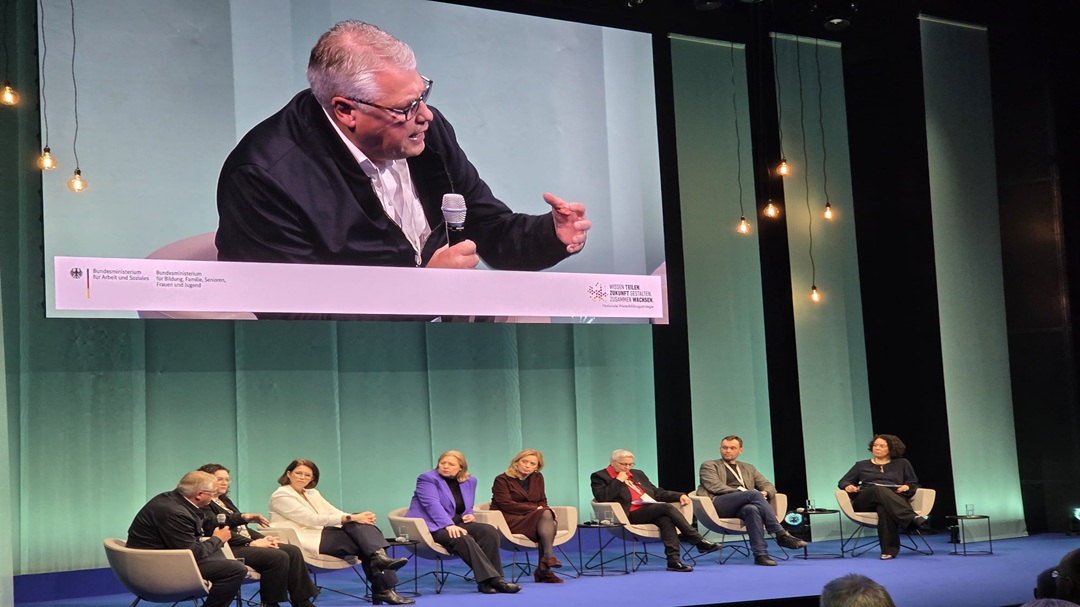
At 10:20 a.m. the stage filled with an impressive line-up,
- Bärbel Bas, Federal Minister of Labour and Social Affairs
- Karin Prien, Federal Minister of Education, Family Affairs, Senior Citizens, Women and Youth
- Christina Ramb, Member of the Executive Board of the BDA employers’ association
- Prof. Dr Friedrich Hubert Esser, President of the Federal Institute for Vocational Education and Training BIBB
- Elke Hannack, Deputy Chair of the German Trade Union Confederation DGB
- Andrea Nahles, Chairwoman of the Executive Board of the Federal Employment Agency BA
- Dr Torsten Kühne, State Secretary for School Construction, School Digitalisation and Lifelong Learning in Berlin
A diverse group from politics, business, unions and academia. And then came the moment that set the discussion in motion.
Andrea Nahles, the spark that opened the debate
Nahles pointed out that continuing education no longer affects only people without formal qualifications. More and more highly skilled workers are coming under pressure as digitalisation and structural change reshape job profiles faster than many can adapt. This noticeably shifted the tone of the discussion. Suddenly the central question became, how do we design learning pathways that truly include everyone, even those we once considered secure.
Elke Hannack, the honest reality check
Hannack voiced what many quietly think, for a lot of people lifelong learning sounds less like a motivating concept and more like life imprisonment. A reminder that the emotional side of learning matters just as much as the structural one.
Dr Torsten Kühne, focusing on the real world levers
Kühne brought in a pragmatic perspective, not everything needs to be regulated from above. We need to regulate less at the top and adjust more at the bottom, meaning the real barriers that stop people from taking part must be addressed first.Together these three statements turned the panel into a genuine conversation rather than a sequence of prepared remarks.
Herzog keynote, work, identity and finding direction in times of change
At 11:30 a.m. Prof. Dr Lisa Herzog, University of Groningen, added a deeper human dimension. She highlighted how strongly people define themselves through their work and educational background and how unsettling it can be when roles, tasks and expectations shift. Her core message, continuing education is not only about skills. It also helps people stay oriented in a working world that is constantly in motion.
Market of Opportunities and Sessions
After the lunch break the Market of Opportunities showcased many practical ideas and projects. From 1:30 p.m. five parallel sessions explored topics such as basic education, qualification pathways, counselling, innovative learning formats and regional cooperation. A recurring theme across all sessions was the importance of networking and collaboration between federal and state levels, employers, education providers and regional partners. A message that aligns perfectly with our role as a networking hub. Later the key insights were summarised in a compact and practice oriented plenary session.
How the day ended and what truly stayed with us
How the day ended and what truly stayed with us
The final discussion focused on what a sustainable culture of continuing education could look like. What became clear:
- the challenges are significant
- solvablethe right actors are already at the table
- and often small adjustments achieve more than sweeping reforms
Above all the day showed that continuing education does not have to sound like life imprisonment. It can sound like opportunity, a chance not only to cope with change but to shape it. And if access becomes easier, bureaucracy is reduced and cooperation strengthened, continuing education might even become something people enjoy, or at least something less daunting than the next software update.
Continuing education can shape the future if we let it.
